





BioPatent Communications
by Gary L. Baker, Patent Attorney
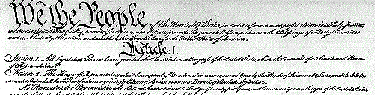 Article I, Section 8
of the Constitution of the
United States, gives the Congress the power to “promote the Progress of Science and
useful Arts, by securing for limited Times to Authors and Inventors the exclusive Right to
their respective Writings and Discoveries”. The Congress has devised a system
to promote science by motivating inventors to make their secrets public. In exchange
for a patent guaranteeing a 20 year right to exclude others from practicing an invention,
the inventor must disclose the entire invention to the public. To be granted a
patent, the invention must be new and not an obvious idea, or a new and nonobvious
modification (improvement) to an old idea. The scope of the patent protection is
limited to the scope of the invention disclosed to the public in the patent application.
Article I, Section 8
of the Constitution of the
United States, gives the Congress the power to “promote the Progress of Science and
useful Arts, by securing for limited Times to Authors and Inventors the exclusive Right to
their respective Writings and Discoveries”. The Congress has devised a system
to promote science by motivating inventors to make their secrets public. In exchange
for a patent guaranteeing a 20 year right to exclude others from practicing an invention,
the inventor must disclose the entire invention to the public. To be granted a
patent, the invention must be new and not an obvious idea, or a new and nonobvious
modification (improvement) to an old idea. The scope of the patent protection is
limited to the scope of the invention disclosed to the public in the patent application.
The invention must be NEW in order to qualify for patent protection. Before an inventor applies for a patent, a novelty search should be made to check the public domain for patents or publications (prior art) that may show another person conceived the invention first. Should prior art be discovered in the novelty search, the invention may not qualify for patent protection. Even if the idea is not entirely new, an inventor can obtain a patent for improvements on the old idea. A patent holder can practice the improvement without interference if the original invention was not protected by an enforceable patent. If the original invention is currently protected by a patent, the improvement generally can not be practiced without a license from the of the original pioneering patent holder.
Patent protection may be denied if prior art is discovered which is so similar to the invention as to render it OBVIOUS. The invention is not patentable if the difference between the invention and prior art would have been obvious at the time of conception to a person having ordinary skill in the field of the invention. The Patent Office may consider your invention "obvious" (see, MPEP 2143) and unpatentable if it is deemed: 1) Combining prior art elements according to known methods to yield predictable results; 2) Simple substitution of one known element for another to obtain predictable results; 3) Use of known technique to improve similar devices (methods, or products) in the same way; 4) Applying a known technique to a known device (method, or product) ready for improvement to yield predictable results; 5) "Obvious to try" - choosing from a finite number of identified, predictable solutions, with a reasonable expectation of success; 6) Known work in one field of endeavor may prompt variations of it for use in either the same field or a different one based on design incentives or other market forces if the variations are predictable to one of ordinary skill in the art; or 7) Some teaching, suggestion, or motivation in the prior art that would have led one of ordinary skill to modify the prior art reference or to combine prior art reference teachings to arrive at the claimed invention.
An inventor can lose the right to a patent a new and non obvious invention if a mistake is made in the patent application. Successful administration (prosecution) of a patent application requires timely, honest and complete disclosure of the invention to the U.S. Patent and Trademark Office (PTO). If an invention is sold or used in public, a patent application must be filed within 12 months or the opportunity will be lost. If the essence of an invention is published, even in a speech to a small group, a patent application must be filed within 12 months. There is not a 12 month grace period for filing in in most foreign countries, such as, e.g., Europe and Japan, once the invention has been sold or published. If an application contains any deceitful expressions, such as intentionally misnaming the inventor, the PTO can render all related patent claims unenforceable. The inventor has a duty to disclose the “best mode” of practicing the invention at the time of filing the application. Failure to do so invalidates the patent.
During prosecution of a patent application, the PTO is required to keep the invention secret until it is published 18 months after initial filing (the Applicant can request continued secrecy, e.g., if they do not to file foreign applications). The inventor may continue employ trade secret protection until the patent is published or granted. When the patent is granted, the invention will no longer be a secret - the invention will be published in the PTO Gazette. All for the better! The world is on notice that the inventor has exclusive rights to the intellectual property. If anyone else wants to use the invention, they can be required to pay licensing fees and royalties.